


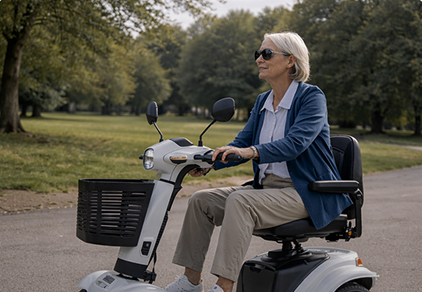
Learning how to choose a mobility scooter is really about matching the scooter to your life, not the other way around. With so many models on the market, from a light folding mobility scooter that slips into a car boot to a road-legal machine built for longer journeys, the choice can feel overwhelming. This UK buyer’s guide breaks it down into plain, practical steps so you can find the best mobility scooter for your needs and buy with confidence.
Start with how and where you will use it
Before looking at any model, think about your daily routine. Will you mostly potter to the local shops and back, or do you want to cover longer distances into town? Do you need to load the scooter into a car, or will it live at home? Is your route mostly smooth pavements, or does it involve kerbs, hills and rougher ground? Your honest answers here will narrow the field faster than any spec sheet.
Understand the classes: Class 2 vs Class 3
In the UK, mobility scooters fall into two legal classes.
Class 2 mobility scooter
A Class 2 mobility scooter has a maximum speed of 4mph and is designed for pavements and pedestrian areas. These are typically smaller, lighter and easier to transport, which makes them a popular choice for shopping trips and shorter journeys. They cannot legally be used on the road except to cross it or where there is no pavement.
Class 3 scooters
A Class 3 scooter can travel up to 8mph and is road-legal, meaning it can be used on the road as well as at 4mph on the pavement. Class 3 models must be registered with the DVLA and have lights, indicators and a horn. They tend to be larger and more powerful, better suited to longer distances and confident outdoor use.
4mph vs 8mph: which speed do you need?
The 4mph vs 8mph question comes down to distance and environment. If your trips are local and mostly on the pavement, a 4mph Class 2 model is usually all you need and is easier to handle. If you want to travel further, along roads or between villages, an 8mph Class 3 scooter gives you the range and pace to do it comfortably. Remember, even an 8mph scooter must drop to 4mph on the pavement.
Boot, pavement and road scooters explained
- Boot scooters (folding mobility scooters): lightweight and designed to dismantle or fold so they fit in a car boot. Ideal if you travel by car or have limited storage. A folding mobility scooter is often the best mobility scooter choice for days out and holidays.
- Pavement scooters: mid-sized Class 2 models built for comfort and stability around town, with a good balance of range and manoeuvrability.
- Road-legal scooters: larger Class 3 models for longer journeys, with lights, suspension and greater battery range.
Comfort and safety for elderly users
Choosing a mobility scooter for elderly users means paying close attention to comfort and ease of use. Look for a supportive, adjustable seat, easy-to-reach controls, and a tiller you can operate without straining. Consider the turning circle if you will use it indoors or in tight shops, and check the maximum user weight and ground clearance. Anti-tip wheels, good lights and reliable brakes all add peace of mind.
Battery range and storage
Battery range is quoted per full charge, but real-world range depends on your weight, the terrain and the weather, so it is wise to allow a comfortable margin. Also think about where the scooter will be stored and charged. If it lives in a garage or shed, make sure you can get it in and out easily.
Try before you decide
A spec sheet can only tell you so much. The best way to find the right scooter is to sit on it, test the controls and see how it feels. You are welcome to explore our full range of mobility scooters online, browse the wider mobility catalogue, or visit our Bilston store to try models in person. As an authorised UK retailer of Drive DeVilbiss and Drive Medical products, we can guide you to a genuine, well-built scooter that suits you.
Frequently asked questions
How do I choose a mobility scooter for an elderly person?
Focus on comfort, stability and simple controls. For local pavement use, a 4mph Class 2 model is usually ideal. Consider seat support, ease of getting on and off, and whether the scooter needs to be transported by car.
What is the difference between a Class 2 and Class 3 mobility scooter?
A Class 2 mobility scooter travels up to 4mph and is for pavements only. A Class 3 scooter reaches 8mph, is road-legal and must be registered with the DVLA.
What is the best folding mobility scooter?
The best folding mobility scooter is the one that suits your weight, storage and travel needs. Look for a lightweight model that folds or dismantles easily and fits your car boot. Our team can help you compare options.
Do I need to register a mobility scooter?
Class 2 scooters do not need to be registered. Class 3 road-legal scooters must be registered with the DVLA, though there is no road tax to pay.
Ready to find your scooter? Browse our mobility scooters and use the enquiry form on any product, or visit our friendly team at the Bilston store for free, no-pressure advice.

